
NFSI

Learning Occupational Safety & Health Through History – Part 2

Learning Occupational Safety & Health through History - Part 2

Continuing the previous blog published on 10th September 2025. Below are some important events in the history of Occupational Safety & Health
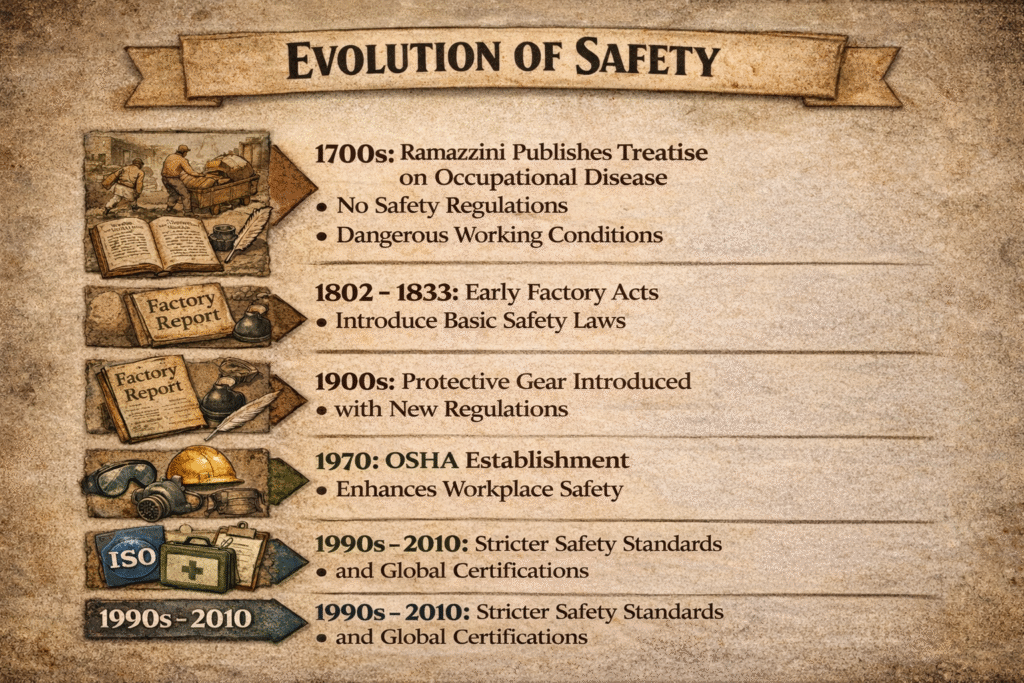
  • 1700 – Ramazzini publishes his treatise on occupational disease
  • 1842 – Right to strike upheld by the Massachusetts Supreme Court (US)
  • 1864 – Pennsylvania Mine Safety Act passed & Issuance of First Accident Insurance Policy in North America
  • 1867 – Massachusetts instituted the first factory inspection
  • 1869 – The Railroad air brake was invented
  • 1877 – Massachusetts passed a law requiring the guarding of dangerous machinery and the authority for factory inspection enforcement
  • 1878 – First recorded call by labour for federal occupational safety & health law (US)
  • 1881 – The American Federation of Labour (AFL) was founded
  • 1885 – The American Public Health Association was founded
  • 1886 – First US Commission of Labour appointed
  • 1896 – The National Fire Protection Association was founded
  • 1902 – The United States Public Health Service was established
  • 1902 – Maryland passed the first US workers’ compensation law
  • 1907 – 362 miners died in a mine disaster, Monongah, West Virginia
  • 1909 – Bureau of Labour study on Phossy jaw released
  • 1910 – The US Bureau of Mines was established
  • 1910 – First National Conference on Industrial Diseases
  • 1911 – The American Society of Safety Engineers was established
  • 1913 – The US Department of Labour was established
  • 1913 – The National Safety Council was established
  • 1916 – The US Supreme Court declared workers’ compensation laws to be constitutional
  • 1921 – The International Labour Organisation set up a safety service
  • 1930 to 1936 – Nearly 2000 Workers died while constructing a tunnel at Gauley Bridge, West Virginia
  • 1934 – The US Bureau of Labour Standards was created
  • 1937 – Congress of Industrial Organisations (CIO) was founded
  • 1952 – Coal Mine Safety Act passed
  • 1954 – The Atomic Energy Act became law
  • 1966 – The Metal & Non-metallic Mines Safety Act was passed
  • 1969 – Construction Safety Act was passed
  • 1971 – National Institute for Occupational Safety & Health (NIOSH) was formed
  • 1972 – OSHA Training Institute established to instruct OSHA inspectors and the public
  • 1972 – The OSHA Standard for Asbestos was issued; the OSHA Construction Safety Standard
  • 1974 – OSHA adopted health standards for 14 Carcinogens
  • 1974 – OSHA Vinyl Chloride standard
  • 1977 – OSHA Diving standard
  • 1978 – New Directions Grants program to foster development of occupational safety & health training and education for employers & workers
  • 1980 – Fire Protection standard updated, and rules established for fire brigades responsible for putting out nearly 95% of worksite fires
  • 1981 – Hearing conservation standard
  • 1984 – Ethylene Oxide rule issued by OSHA
  • 1987 – Farmworkers standard issued; Benzene standard issued
  • 1989 – Hazardous waste operations and emergency response standard
  • 1989 – Lockout/Tagout of hazardous energy sources standard issued
  • 1989 – Excavation & Trenching Operations Standard
  • 1992 – Process Safety Management of Highly Hazardous Chemicals standard adopted
  • 1994 – First Expert Advisor software, GoCad, issued to assist employers in complying with OSHA’s cadmium standard
  • 1994 – Asbestos standard updated to cut permissible exposures in half
  • 1996 – Scaffold standard published
  • 1997 – Methylene Chloride standard issued
  • 1997 – California adopts the Ergonomic standard
  • 2001 – Recordkeeping rule revised to improve the system
  • 2002 – OSHA instituted a new recordkeeping guideline and reporting forms
  • 2003 – Ergonomics guidelines issued for the nursing home industry
  • 2003 – Final rule established criteria for recording work-related hearing loss
  • 2004 – OSHA unveils its National Emergency Management Plan
  • 2004 – Ergonomics guidelines published for retail grocery stores
  • 2004 – Ergonomics guidelines announced for the poultry processing industry
  • 2004 – OSHA issues Fire Protection in Shipyard Employment Standard
  • 2009 – OSHA issues standard to facilitate Hazard Communication – Global Harmonisation System
  • 2010 – OSHA holds National Action Summit on Health & Safety for Latino Workers
  • 2010 – OSHA issues regulation for Falls in General Industry
  • 2010 – OSHA initiates an Injury and Illness Prevention Program Initiative
  • 2010 – A new standard on Cranes and Derricks was issued.


National Fire Safety Institute

We Offer Training For Fire Safety

Disclaimer:
This blog post is for informational purposes only and is not a substitute for professional fire safety advice. Always consult with experts for specific safety recommendations and guidance.

We hope you found this information helpful. Stay safe and be prepared!

Share This :

Leave a Reply

Your email address will not be published. Required fields are marked *

Related Blogs