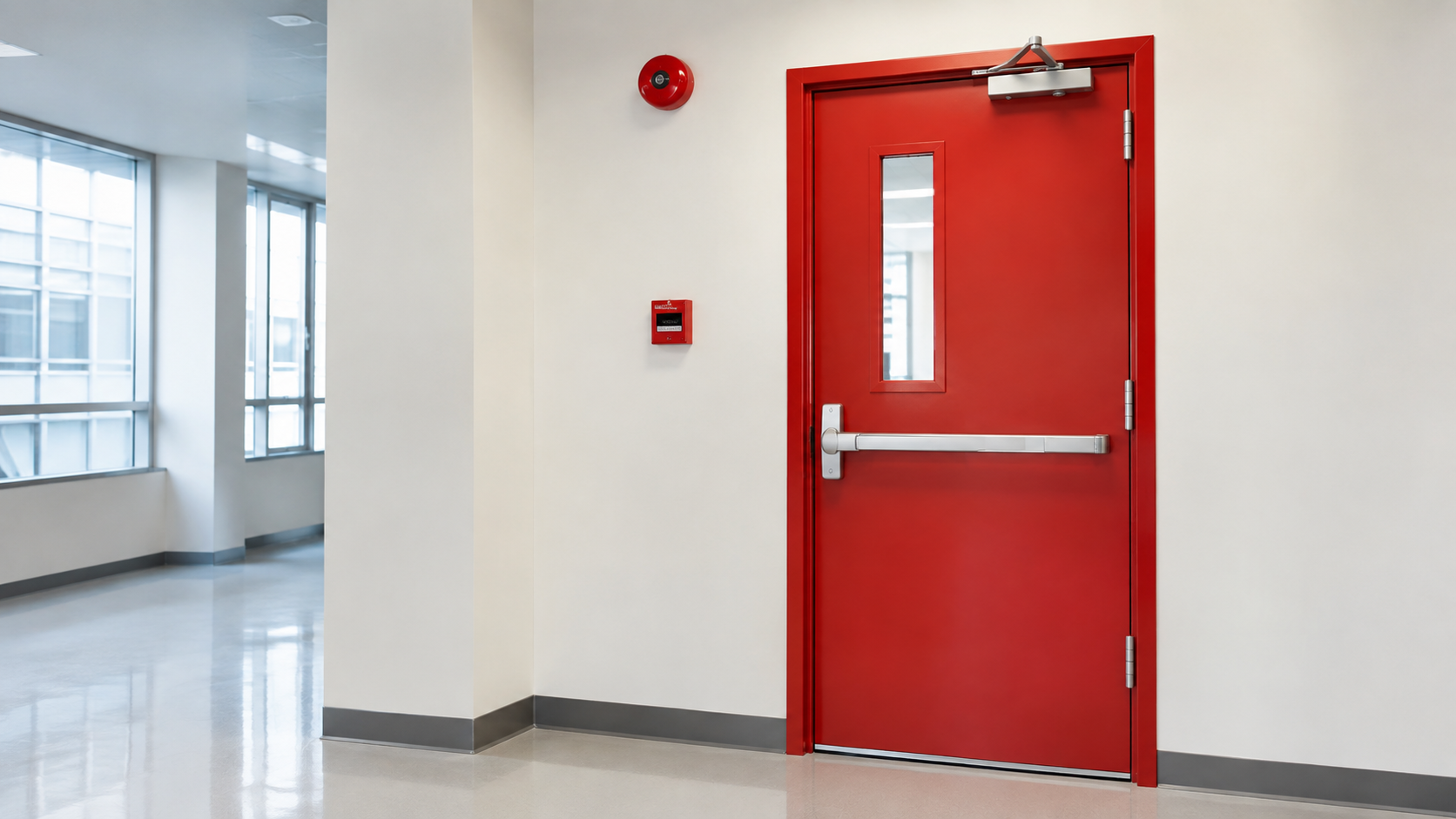
Fire Door Safety: Importance, Types, Inspection & Maintenance Guide
Fire Door Safety: Importance, Types, Inspection & Maintenance Guide NFSI India September 11, 2026 Fire Door Safety: How Fire Doors...

Vadodara, Gujarat
NFSI India
September 11, 2026
Learn how fire doors protect lives during a fire.
Understand fire door types, placement, inspection, maintenance, common mistakes, and workplace fire safety practices.
During a fire emergency, every second matters.
A fire can spread rapidly through a building, filling corridors and stairwells with flames, heat, and smoke. While fire alarms, sprinklers, extinguishers, and evacuation procedures are essential, one important component of passive fire protection often receives less attention:
The fire door.
A properly designed, installed, closed, and maintained fire door can help slow the spread of fire and smoke, allowing occupants more time to evacuate and helping protect escape routes.
However, a fire door is effective only when it is correctly installed and maintained.
A damaged door, missing closer, excessive gaps, or a door that is permanently wedged open can compromise its intended performance.
This guide explains what fire doors are, how they work, where they are used, why maintenance matters, and what organizations should check regularly.
A fire door is a specially designed door assembly intended to resist the spread of fire and, depending on its design and rating, smoke for a specified period.
Unlike an ordinary door, a fire door is part of a passive fire protection system.
A complete fire door assembly may include:
The performance of the complete assembly matters—not simply the door itself.
When properly installed and closed, a fire door helps create a barrier between different areas of a building.
During a fire, it can help:
The door is designed to resist fire for a specified period under applicable testing requirements.
Where the assembly includes appropriate smoke-control features, seals can help reduce smoke leakage.
Fire doors can help protect corridors, staircases, and other designated escape routes from fire and smoke.
Delaying fire and smoke spread can give occupants additional time to evacuate and allow emergency responders to operate more safely.
A building’s fire safety strategy should not rely on active systems alone.
Fire doors are an important part of passive fire protection because they do not need someone to activate them during a fire when properly maintained and used as intended.
They can help:
Fire doors may be found in many types of buildings, depending on the building design, fire strategy, occupancy, and applicable requirements.
Particularly important because evacuation can be complex and some occupants may have limited mobility.
Fire doors may be used to protect:
They can be used around:
Fire doors can help protect escape routes and separate different sections of a building.
Fire doors are particularly important around protected staircases and other fire-rated compartments.
Fire doors are generally assigned performance ratings based on applicable standards and testing procedures.
You may see ratings expressed in terms such as:
30 minutes, 60 minutes, 90 minutes, or more.
However, the correct rating depends on the building’s fire strategy, wall construction, occupancy, location, and applicable requirements.
A common mistake is assuming that every fire door has the same rating. It does not.
The required rating should be determined according to the applicable building design and fire safety requirements.
Understanding the components makes inspection easier.
The main door panel is constructed using materials designed to provide fire resistance.
The frame must be compatible with the door assembly. A fire-rated door installed in an unsuitable frame may not provide the intended protection.
Fire-rated hinges help ensure that the door remains securely supported during normal operation and fire exposure.
The door closer allows the door to return to its closed position. This is extremely important. A fire door that remains open when it needs to be closed may not provide the intended barrier.
Intumescent materials expand when exposed to high temperatures and help seal gaps around the door assembly.
Where specified, smoke seals help reduce smoke leakage around the door edges.
The door should close and latch correctly as designed.
One of the most common fire door mistakes is keeping a fire door permanently open using:
If a fire occurs, the open door may allow fire and smoke to spread rapidly between compartments.
Instead:
If a fire door needs to remain open for operational reasons, only an approved hold-open or automatic release arrangement, where permitted and properly installed, should be used.
The arrangement should be compatible with the building’s fire strategy and applicable requirements.
Organizations should regularly inspect fire doors for visible defects and operational problems.
Check the Door Look for:
Check the Frame Look for:
Check Hinges Ensure:
Check the Door Closer The door should:
Check Seals Inspect for:
Check Gaps Excessive or inconsistent gaps around the door can affect performance.
Any gap requirements should be assessed against the door’s certification and applicable guidance rather than relying on a generic measurement.
This can compromise compartmentalization.
Removing or disabling the closer can prevent the door from closing when needed.
Unauthorized modifications can affect the door's tested performance.
Not every hinge, lock, closer, or vision panel is suitable for a fire-rated door assembly.
Missing or damaged seals can compromise the assembly.
Improper maintenance or coatings can affect components and identification.
| Feature | Fire Door | Ordinary Door |
|---|---|---|
| Fire resistance | Designed and tested for specified performance | Not necessarily fire-rated |
| Smoke control | May include smoke-control features | Usually not designed for this |
| Door closer | Often an important component | May not have one |
| Special seals | May include intumescent/smoke seals | Generally absent |
| Certification | Should be supported by appropriate documentation | Usually not fire-rated |
| Purpose | Passive fire protection | Normal access/privacy/security |
Fire doors should be considered as part of the overall evacuation strategy.
A well-designed emergency plan should consider:
Employees should understand that closing fire doors can be an important part of containing fire and smoke, but they should never delay evacuation to close doors if doing so puts them at risk.
Fire compartmentalization and fire doors can therefore play an important role in a hospital’s overall fire safety strategy.
Fire doors can help separate higher-risk areas from other parts of a facility when incorporated into the building’s fire strategy.
A fire door is a physical safety barrier.
But employees are the people who interact with it every day.
This is where Fire Safety Training becomes important.
A well-trained employee may notice a damaged closer or missing seal before it becomes a serious safety concern.
A professional Fire Safety Audit can help identify issues involving:
Fire doors should not be viewed in isolation.
They should be assessed as part of the building’s overall fire safety strategy.
At NFSI (National Fire Safety Institute), we believe effective fire safety requires a combination of proper systems, trained people, and continuous preparedness.
Our fire safety solutions include:
Our practical approach helps organizations identify hazards, improve preparedness, and develop a stronger safety culture.
Fire doors may look like ordinary doors, but they can play a critical role in passive fire protection.
When correctly specified, installed, maintained, and used, they can help slow the spread of fire and smoke and protect important escape routes.
However, even the best fire door cannot compensate for poor maintenance or unsafe practices.
Do not wedge it open. Do not ignore damage. Do not remove critical components.
Inspect it. Maintain it. Keep it functional.
Because during a fire emergency, a door that works as intended can make a critical difference.
A fire door is a specially designed door assembly intended to resist the spread of fire and, where applicable, smoke for a specified period when correctly installed and maintained.
An open fire door may allow fire and smoke to spread between areas that are intended to be separated. Fire doors should generally remain closed unless an approved hold-open/release system is provided where permitted.
Fire doors should be checked regularly as part of the building’s fire safety management system, with the frequency determined by the building’s risk, usage, applicable requirements, and manufacturer’s guidance.
No. Hardware should be compatible with the specific fire door assembly and its certification or approval requirements.
Not necessarily. Requirements depend on the building’s design, occupancy, fire strategy, applicable building regulations, and other relevant requirements.
Report it immediately to the responsible facilities, maintenance, or fire safety team and arrange appropriate inspection and repair.
Disclaimer:
This blog post is for informational purposes only and is not a substitute for professional fire safety advice. Always consult with experts for specific safety recommendations and guidance.
We hope you found this information helpful. Stay safe and be prepared!
Fire Door Safety: Importance, Types, Inspection & Maintenance Guide NFSI India September 11, 2026 Fire Door Safety: How Fire Doors...
Best Fire Safety Training in Vadodara & Gujarat | NFSI NFSI India September 10, 2026 Why NFSI Is One of...
Raksha Bandhan & Fire Safety | The True Meaning of Protection Beyond the Festival NFSI India August 26, 2026 Celebrate...